Showing posts with label Old Testament. Show all posts

Tuesday, July 1, 2014

"Theory of Mind" Exposed as Delusional Thinking

It turns out that the vaunted psychological “Theory of Mind” is psychology's euphemism for delusional thinking; a supernatural, superstitious, and magical type of brain processing common to “normal” people. Anyone who demonstrates rational, science-based thinking is abnormal.
 
The fact that Scientific American would publish this is shocking.
____________________________________
People with Asperger’s less likely to see purpose behind the events in their lives By Karen Schrock | May 29, 2010 |SCIAM BLOGS

BOSTON—Why do we often attribute events in our lives to a higher power or supernatural force? Some psychologists believe this kind of thinking, called teleological thinking, is a by-product of social cognition. As our ancestors evolved, we developed the ability to understand one anothers’ ideas and intentions. As a result of this “theory of mind,” some experts figure, we also tend to see intention or purpose—a conscious mind—behind random or naturally occurring events.
A new study presented here in a poster at the 22nd annual meeting of the Association for Psychological Science supports this idea, showing that people who may have an impaired theory of mind are less likely to think in a teleological way. 
Bethany T. Heywood, a graduate student at Queens University Belfast, asked 27 people with Asperger’s syndrome, a mild type of autism that involves impaired social cognition, about significant events in their lives. Working with experimental psychologist Jesse M. Bering (author of the "Bering in Mind" blog and a frequent contributor to Scientific American MIND), she asked them to speculate about why these important events happened—for instance, why they had gone through an illness or why they met a significant other. As compared with 34 neurotypical people, those with Asperger’s syndrome were significantly less likely to invoke a teleological response—for example, saying the event was meant to unfold in a particular way or explaining that God had a hand in it. They were more likely to invoke a natural cause (such as blaming an illness on a virus they thought they were exposed to) or to give a descriptive response, explaining the event again in a different way.
 
Once again we see that so-called scientific studies by psychologists are tainted by a bizarre insistence that delusional (magical-supernatural-religious thinking) is required in order to be a socially-acceptable human, and indeed that supernatural belief is necessary to social acceptance. Is it surprising then that American education is deficient in science and math instruction, and is instead focused on magical social ideas like the insistence that smiley face stickers 'create' self-esteem? 
It's unbelievable!

Friday, May 2, 2014

Myths about Asperger Women

This Esquire magazine cover is from the 1960's, and despite equal rights legislation, nothing has really changed, because hatred of women is embedded in American culture. Women are bombarded by the message that we are childlike idiots whose sole purpose is defined by men, and utterly disposable when we fail to conform to their prescriptions. Self-hatred is learned by girls through socialization, and demonstrates the susceptibility of the "normal" brain to "brain-washing."

Asperger females are accused of being unfeminine and unattractive. The old male prejudice that any woman who is competent, intelligent, and ambitious must therefore be 'masculinized' is still being propagated by psychologists. Asperger females are accused of having a "male brain," which effectively ejects us, and all smart women, from the female half of humankind.

It's quite a compliment, if you think about it.

Tuesday, April 29, 2014

What Asperger children are doing with their brains when regular people think we are standing around being defective.

I was an uncomfortable child. I didn’t like the world much, and it didn’t like me. The world was confusing - disturbing, jarring, and alarming. I was frightened most of the time and most everything frightened me. Within my mind I was adventuresome and fearless, but people and their invasive habits and their intrusive rules and demands, scared the shit out of me. I didn’t know it, I instincted it. They wanted to keep me from adventure, from thought, and from truth. I hid. I still hide, because I was right. Social people confine and limit each other in terrible ways.

Women are confident that the man they live with is a nice guy and a good father. He’s just an average man, not a leader. Leaders know how to bring out the killer in every man. That’s why they are leaders. Men were a giant intellectual obstacle when I was a child. In their estimation of how things work, I was an insatiable little monster whose curiosity, hidden passion, obstinacy, questions, and rational seeking would be fine…if only I had been born a boy. How I learned to hate that pejorative and final indictment. 
Unbelievably, it was adult women who were most often the delivers of this life sentence of inferiority; women whose natural grace was replaced by restrictive clothing, rock hard hairstyles and icing-like make up, until nothing original remained. It was the 1950s and rigid sex rules demanded rigid bodies. Underwear was compiled in layers of girdles, brassieres, slips and garter belts, and stockings with seams that must be straight. Our mothers were Virgin priestesses who had been ceremoniously demoted by marriage, shamed and gagged by the function of their sex. I horrified my mother. I was not what she wanted in a child. My very existence challenged her acceptance of marriage as a woman’s inevitable defeat. My lively mind was a reminder of a dark female presence that she had murdered within herself.
The game unfolded: little girls were soon tamed. Female society ground on like a glacier that rolled over and pulverized every female that resisted its relentless power.
My father was a traitor to his gender. In matters of the mind he never slighted me. He was a mechanical engineer with wide interests, but his knowledge had one boundary, the artificial gulf between the priestly triumvirate of science, technology, and mathematics, the intellectual activities that divided the real world from everything else. He had an eidetic memory (he claimed) and rather than deflect my questions as unladylike annoyances, he fed me information about astronomy, geology, physics, chemistry, history, exploration and industry. He was not a creative person, but populated his mind with wonderful facts and figures in order to keep the world and his unhappy childhood at bay. He told me this, and let me know, without providing details, that he had idolized his father, a strict man who had used corporal punishment to toughen him up. 

Inexplicably, he hated his mother, whose sole flaw, as far as I could understand, was being a woman. His sister was also an object of his rage. He refused to provide any cause for his extreme feelings, and if my questions ventured to close to his wall of secrecy, he would turn on me. The experience was like that of trying to retrieve a bone from an ill-tempered dog that growls menacingly, curls its lip and commits a warning bite. Warning given: warning taken. I had to set aside this mystery concerning his female family members as a contradiction to the father I knew.


Monday, April 28, 2014

Standing Around Being Defective 2

My father was unhappy with social rules that he simply couldn’t comprehend. He sympathized with my complaints about female socialization and gave me a pass on conforming to what we both judged to be ridiculous and humiliating demands placed on women. Once in awhile, at some critical stage when my mother would insist that I dress up “like a lady” and attend some social function, he would sacrifice me to marital peace and order me to obey.

When I directly contradicted his strict adherence to the triumvirate of science, technology and mathematics as the only worthwhile human endeavors, he withdrew angrily. When I defended art, literature, foreign cultures and music as areas of growing interest to me, I witnessed the rigid and deranged male vision of superiority. I was swiftly demoted from being an equal and temporarily cast out as one of them, a category that included all lesser beings: women, minorities, artists, musicians, writers - literally, anyone who was not a white male engineer or scientist. It hurt terribly and compounding his vile attitude was the equally legitimate observation that my father was not an unkind man. His kneejerk hatred toward categories of lesser humans did not play out in daily life. He was helpful to neighbors and to strangers regardless of category, to the point of exasperating my mother with his generosity. He was an unrepentant chit-chatter with any and all who came his way. I never heard an unfriendly word in his conversations unless the topic turned to politics. It was then that the conservative white male monster emerged and we had to drag him out of the situation to avoid a confrontation. In the 1950s such unhinged political behavior was rejected as out-of-bounds, but today it has become main stream political behavior spread by rabid and irrational media ‘news.’

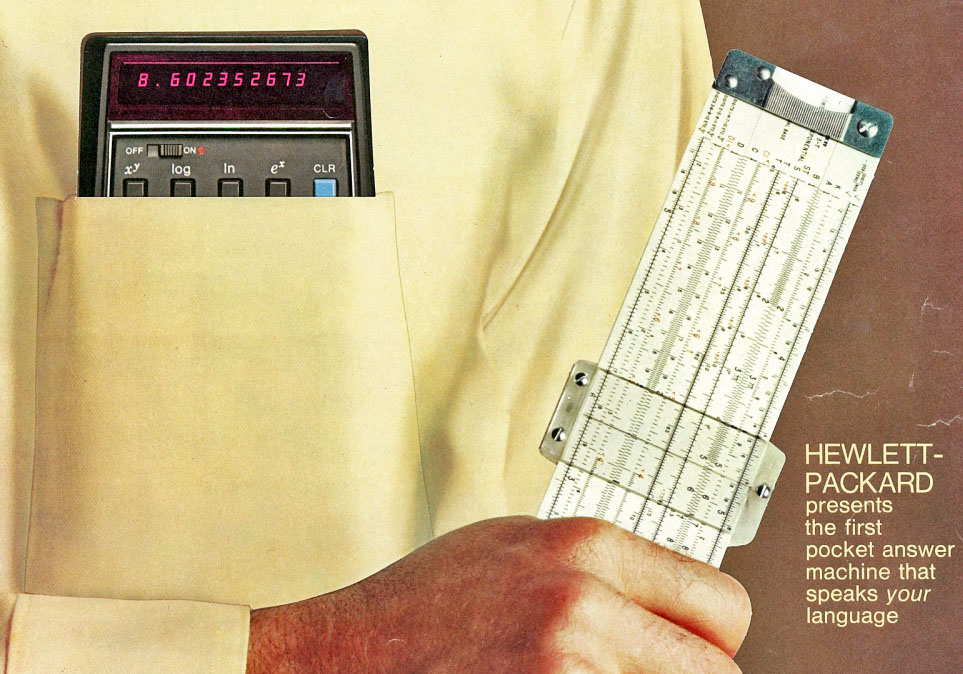
One of the highlights of my father's career in engineering
was the monumental leap from slide rule to the HP 35.

I was stuck with a schizoid model: Everything human was on the other side of the divide in my father’s male world. Female thoughts and opinions simply didn’t matter, and worse, formed some kind of cosmic threat to men. And yet, my father did not impose the standard “women are stupid, emotional, and should never attempt to think” regime on me, but encouraged my heresy. I think he also grasped that any censure of my particular interests would be fruitless. This conflict set me up for a lifelong interest in human behavior.

My hidden analysis of the family proved that both my father and mother were extreme cases of people who were locked into behavior they could neither understand nor modify. It turned out to be not that simple. Although their extremes were dysfunctional, each parent reflected common cultural beliefs promulgated by a particularly unhealthy supernatural script, which had been enacted over and over with tragic success for two millennia.  
When I look back to my childhood I see it ironically. The painful dysfunctional predicament in which I found myself provided material for a favorite type of Asperger challenge. What a mess! I bet I can figure it out. I'm still working on it.