 |
| No problemo! My visual brain could spin the wooden models that (no longer) are used to learn crystal forms, while other students were on the verge of emotional breakdown when tasked with this test.
First panic, then strategy: I signed up for Calculus based physics before taking a Calculus course. I had to 'see' what Calculus looked like in the real world. It worked; I passed physics by sacrificing a few points on the mathematics while storing equations as whole images, and giving them names like, "the double violin with a thingy under the roof" and attached the image to a process for solving the equation. I had no idea what the equation described mathematically, but I could usually solve it. Calculus texts aid this approach since each chapter is organized by groups of similar equations.
I had no problem with the math that describes geologic processes like stream flow, because I could easily see the realization in nature. So, physics itself was understandable as it applies to the familiar world of motion, energy and behavior of objects, but getting through Calculus as a foreign language was like decoding signals from a very advanced and very alien civilization.
Graphs! A visual window into the abstract language of mathematics. From Paul's online math notes: http://tutorial.math.lamar.edu "Now, let’s take a look at just how we could possibly get two tangents lines at a point. This was definitely not possible back in Calculus I where we first ran across tangent lines. A quick graph of the parametric curve will explain what is going on here. So, the parametric curve crosses itself! That explains how there can be more than one tangent line. There is one tangent line for each instance that the curve goes through the point."  For me graphic images, which can be quite a distraction due to their beauty, do help, but in order to 'do math' I had to approach maths as foreign languages. The analogy is fitting: one can learn the forms and grammar of another language, but never become fluent, nor speak it like a native. |
Showing posts with label psychology. Show all posts
Showing posts with label psychology. Show all posts
Wednesday, July 9, 2014
Problems with Visual vs. Abstract Thinking: Calculus
Examples from my college days preserve vividly the difference between those who think visually and those who are adept at abstract thinking. Although visual 'talent' as it was sometimes referred to, was a big bonus for studying geology, from geomorphology (landforms), to mineralogy (the crystal classification system) to structural geology (deconstructing relationships in space and time), in order to earn a degree, geology students were required to pass three semesters of Calculus and Calculus-based physics. I am not an abstract thinker; once mathematics leaves 'Concrete World' my visual mind simply goes blank - literally.

Saturday, June 21, 2014
Heavyweight Psychology Wars: Piaget vs. Vygotsky

Piaget is famous for his 4 stages of development, in which children are like trains that must arrive at specific stations on time. This schedule is absolute, in that behavior and cognitive development is "written" in the Big Book of Universal Law, and any deviation from the rule is a sign of a defective child. Also, children are on their own when learning: children must "discover" knowledge by themselves, without social interference, which begs the question, why do we build schools and hire teachers?
 |
| How bizarre! The advantage of the long and open window of learning in humans, is that it's efficient! The individual doesn't have to re-discover a vast trove of existing knowledge, which no individual could possibly do, but has the tremendous advantage of learning from OTHER HUMANS, even those who died long ago. |
In my opinion, Piaget's demands are highly unrealistic (indeed wacky) and are founded in religious prescriptions (supernatural ) rather than being scientific. According to Piaget, a child's behavior must conform to a specific set of instructions, regardless of his or her environment, culture, or social reality. Individual talents and personality 'don't count.' Whether or not a child is born in Madagascar, Siberia, or California, this scheme for learning and development is The Scheme. Wow! Sounds like the justification for the American tradition of Corporate / Religious take over (extermination) of cultures around the world.
1. Vygotsky maintained that the cultural and historical context in which the child is born is vital in child learning and development. 2. There are no "stages" of prescribed development. Children develop along a curve, not in steps. 3. Children learn, not in isolation, but from the adults around them, who provide knowledge and demonstrate skills that help the child to think in increasingly advanced ways until they can function as adults - on their own. Wow! Sounds like a Commie Plot to me!
The tragedy of Psychology Wars, is that American public schools have become the laboratories / battlefields on which competing theories are being tested. Theories are weaponized, politicized and bastardized in the hands of educators, school boards, parents, teachers, consultants, so-called experts, lawyers and publishers - armies of contestants in the dash for funding, contracts, grants and salaries. Meanwhile, classroom applications of competing psychologies, which are falsely presented as scientific fact, work at cross-purposes in the classroom, and serve to destroy education.
How does this clash between Titanic Theories of Psychology affect learning and development in Asperger children and - importantly - how society judges us?
________________________
Need I say more? This is not how the world works: this is how psychologists remake the world in their own irrational image.

Monday, April 28, 2014
Standing Around Being Defective 2
My father was unhappy with social rules that he
simply couldn’t comprehend. He sympathized with my complaints about female
socialization and gave me a pass on conforming to what we both judged to be
ridiculous and humiliating demands placed on women. Once in awhile, at some
critical stage when my mother would insist that I dress up “like a lady” and
attend some social function, he would
sacrifice me to marital peace and order me to obey.
When I directly contradicted his strict
adherence to the triumvirate of science, technology and mathematics as the only
worthwhile human endeavors, he withdrew angrily. When I defended art, literature, foreign cultures and
music as areas of growing interest to me, I witnessed the rigid and
deranged male vision of superiority. I was swiftly demoted from being an
equal and temporarily cast out as one of them, a category that included all
lesser beings: women, minorities, artists, musicians, writers - literally,
anyone who was not a white male engineer or scientist. It hurt terribly and
compounding his vile attitude was the equally legitimate observation that my
father was not an unkind man. His kneejerk hatred toward categories of lesser
humans did not play out in daily life. He was helpful to neighbors and to
strangers regardless of category, to the point of exasperating my mother with
his generosity. He was an unrepentant chit-chatter with any and all who came
his way. I never heard an unfriendly word in his conversations unless the topic
turned to politics. It was then that the conservative white male monster emerged
and we had to drag him out of the situation to avoid a confrontation. In the
1950s such unhinged political behavior was rejected as out-of-bounds, but today
it has become main stream political behavior spread by rabid and irrational media
‘news.’
I was stuck with a schizoid model: Everything human was on the other side of the divide in my father’s male world. Female thoughts and opinions simply didn’t matter, and worse, formed some kind of cosmic threat to men. And yet, my father did not impose the standard “women are stupid, emotional, and should never attempt to think” regime on me, but encouraged my heresy. I think he also grasped that any censure of my particular interests would be fruitless. This conflict set me up for a lifelong interest in human behavior.
My hidden analysis of the family proved that both my father and mother were extreme cases of people who were locked into behavior they could neither understand nor modify. It turned out to be not that simple. Although their extremes were dysfunctional, each parent reflected common cultural beliefs promulgated by a particularly unhealthy supernatural script, which had been enacted over and over with tragic success for two millennia.
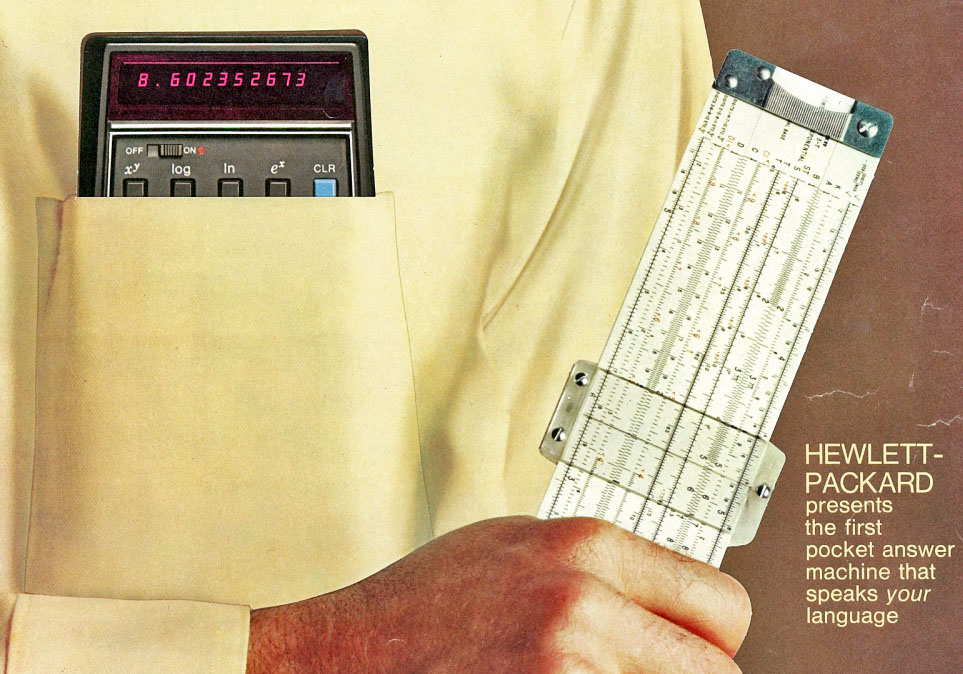 |
| One of the highlights of my father's career in engineering was the monumental leap from slide rule to the HP 35. |
I was stuck with a schizoid model: Everything human was on the other side of the divide in my father’s male world. Female thoughts and opinions simply didn’t matter, and worse, formed some kind of cosmic threat to men. And yet, my father did not impose the standard “women are stupid, emotional, and should never attempt to think” regime on me, but encouraged my heresy. I think he also grasped that any censure of my particular interests would be fruitless. This conflict set me up for a lifelong interest in human behavior.
My hidden analysis of the family proved that both my father and mother were extreme cases of people who were locked into behavior they could neither understand nor modify. It turned out to be not that simple. Although their extremes were dysfunctional, each parent reflected common cultural beliefs promulgated by a particularly unhealthy supernatural script, which had been enacted over and over with tragic success for two millennia.
When I look back to my childhood I see it ironically. The painful dysfunctional predicament in which I found myself provided material for a favorite type of Asperger challenge. What a mess! I bet I can figure it out. I'm still working on it.
Friday, March 21, 2014
Wrong Answers Cause Wrong Behavior in Neurotypicals

Social conflict makes me ill. Literally.
Asperger people often find themselves in the awkward position shown by this graphic. Two groups of socially typical people fight over control of The Answer and neither group has a clue that The Answer they are fighting over is no answer at all; each group merely wants control.
The unfortunate Aspie (2) may or may not have the correct answer, but he or she knows that The Answer being fought over is simply not correct: the fight isn't about facts, but about which group is Right.
Asperger individuals are obsessed with problem-solving and want to get everyone on track toward finding a solution. The result is that both groups will turn on the Asperger and attack, often viciously, the one person who might be able to help.
Asperger people need to learn that Neurotypicals aren't looking for solutions at all! They love to fight, and are addicted to negative emotions, aggression and above all Winning, and they will argue unsuccessfully over the same topics again and again.
Tuesday, March 11, 2014
Man at the top of a garbage heap, but closer to God.

Researchers have become Lords of the Brain, the prescribers and manipulators of human destiny. Who are these individuals who have taken it upon themselves to decide which human beings are normal and which ought to be “tweeked, changed or fixed,” whether with drugs or biomedical engineering? Some scientists have abandoned life in order to create perfect obedient robots to replace an imperfect creature of evolution.
What a dangerous idea. Humans have been ‘perfecting’
the environment for thousands of years; perfecting domestic animals and plants,
overriding natural processes and polluting the earth. Know-it-alls have brought
us to the brink of self destruction and created a mess of social disharmony and physical suffering justified
by an archaic idea: God gave the earth to man to disrupt, loot and rape. Man at the top of a garbage heap, but
closer to God.
Friday, March 7, 2014
Neurotypicals are the true Black and White thinkers
The non-scientific term ‘black and white thinking’ pops up
like a rash all over on the internet, in popular pseudoscience websites about
autism and Asperger people. It also appears in articles written by psychologists,
and has many synonyms: concrete, literal, all-or-nothing, dichotomous, polarized,
and primitive thinking.
 Asperger’s Syndrome and Nonverbal Learning Disorder from Orion Academy:
California, a school for children with Neurocognitive disabilities. “…are very concrete thinkers, viewing everything dualistically—black and white, all or nothing, good or
bad; keep in mind that everything you say
to them will be taken literally.”
Asperger’s Syndrome and Nonverbal Learning Disorder from Orion Academy:
California, a school for children with Neurocognitive disabilities. “…are very concrete thinkers, viewing everything dualistically—black and white, all or nothing, good or
bad; keep in mind that everything you say
to them will be taken literally.”
This statement is breathtaking in its black and white characterization of Asperger people. The use of “everything” and “everything you say” is indicative of black and white thinking. The writer sounds angry; the real point of the mini-tirade is that children are expected to be obedient, but that Asperger children are egalitarian, operate on facts, and have a terrific instinct for lies.
 Black-and-White
Thinking
Black-and-White
Thinking
Another associated trait (with Asperger’s) is 'black-and-white thinking.' There are several definitions of this term: The fallacy that anything must be true of either all or none of any group (an instance of the Fallacy of False Dilemma).
I was shocked when I first encountered the claim that Asberger individuals
are limited to black and white thinking; I personally use several
thinking processes, including visualization, in order to navigate and understand the world. Each
type of processing has its function; one or more processes may be appropriate
or useful in any particular situation. More
about that later.

Let’s start with some uses of 'black and white
thinking' in articles, since writers rarely include a definition. Psychologists conveniently leave out 99.99% of what life and the universe are about: FACTS, a prejudice that effectively erases what an Asperger is.
From the book – Asperger
for Dummies
Concrete “black-and-white” thinking. Many people with
Asperger Syndrome don’t understand unspoken rules, due to difficulties with
interpreting figures of speech and nonverbal communication. They tend to rely
solely on the words themselves. Difficulty with perceiving nonverbal
communication causes significant challenges during social interaction. The same characteristic holds true for people with more classic autism. However, this
trait tends to be more startling in those with Asperger Syndrome, due to their
often superior verbal skills. Despite the fact that many persons suffering with
Asperger Syndrome have high IQs, due to challenges in understanding the
unspoken rules of employment, they’re greatly challenged in being successful at
a typical job.
From this description
we must conclude that having “superior verbal skills” leads to black and white
thinking and that rules of employment ought to remain undefined and hidden –
which is ridiculous; this common practice furthers discrimination, unequal pay
and anxiety in employees. Overall the paragraph leaves the impression that
neurotypicals are too lazy to acquire verbal competence and that reading body
language is the most important qualification for employment, not talent, skills
and hard work. As an Asperger individual who has worked in the business sector,
“rules of employment” is code for kissing the boss’s ass and spending many
hours of each day pretending to agree with those who have power in the hierarchy.
If “mind / body reading”
is so important, why do businesses and individuals rely on contracts? If one
must be in the physical presence of another human in order to "read" facial expressions and body language, how
did the telephone ever get off the ground? Books? Email? Written letters? Faxes?
This statement is breathtaking in its black and white characterization of Asperger people. The use of “everything” and “everything you say” is indicative of black and white thinking. The writer sounds angry; the real point of the mini-tirade is that children are expected to be obedient, but that Asperger children are egalitarian, operate on facts, and have a terrific instinct for lies.
Another associated trait (with Asperger’s) is 'black-and-white thinking.' There are several definitions of this term: The fallacy that anything must be true of either all or none of any group (an instance of the Fallacy of False Dilemma).
- 1.A tendency to evaluate anything as all good or all bad.
- 2. A mode of thought concerned with definite, observable facts (e.g., "The sky is blue," "The Eiffel Tower is in Paris") as opposed to vague judgments ("Chewing with your mouth open is inappropriate")
3. A mode of thought that utilizes a scientific theory of the Universe.
4. Mathematical thinking.
This list contains a huge clue as to why
social people mistakenly claim that Asperger individuals exhibit black and white thinking. We operate on FACT, whereas social individuals abhor facts. Many people who are considered to be normal, such as religious fundamentalists, deny that facts exist. Facts are inconvenient because they get in the way of
social coercion, manipulation of individuals and groups, and the incessant
negotiation of status with the social hierarchy. Lies, not facts are the basis of
social interaction.
Monday, March 3, 2014
Asperger's individuals show higher than normal Fluid Intelligence
Superior fluid intelligence (abstract reasoning ability) in children with Asperger’s disorder
Abstract
Asperger’s disorder is one of autistic spectrum disorders; sharing clinical features with autism, but without developmental delay in language acquisition. There have been some studies of intellectual functioning in autism so far, but very few in Asperger’s disorder. In the present study, we investigated abstract reasoning ability, whose form of intelligence has been labeled fluid intelligence in the theory of Cattell [Cattell, R. B. (1963). Theory of fluid and crystallized intelligence: A critical experiment. Journal of Educational Psychology, 54, 1–22.], in children with Asperger’s disorder. A test of fluid intelligence, the Raven’s Standard Progressive Matrices Test, was administered to 17 children with Asperger’s disorder and 17 age-, gender-, and FIQ-matched normal children. The results showed that children with Asperger’s disorder outperformed on the test of fluid reasoning than typically developing children. We suggest that individuals with Asperger’s disorder have higher fluid reasoning ability than normal individuals, highlighting superior fluid intelligence.
Saturday, March 1, 2014
Pain, Empathy and Emotion: Scientific Version
I want to go ahead today and add a response I posted on an Asperger website
after another poster quoted from "The Simpsons." The idea in the quote relates to the Asperger / Social Majority conflict over emotion and a possible explanation for the misunderstanding.
Homer to Marge: "You don't appear to be in any kind of physical pain, the only type of pain a man understands".
I am female, but I am unable to tell the difference between physical and emotional pain. There are times I've gone to a medical doctor, because I really can't figure out if I'm sick or upset. This led me to read about how the brain processes pain and "feels" emotions. Guess what? There is only one circuit for both - emotional pain is physical. How could it be otherwise unless you believe that emotions are supernatural, which I'm sure many social people believe.

Only three or four emotions exist: the flight or fight response of aggression and fear; disgust, and pleasure. From my own experience, I suspect that Asberger individuals experience a default "neutral" state. Social children learn to diffuse and differentiate their basic pain responses and to give those new states names - it's a fundamental task of social training. This is especially true for females. Inflating and dispersing pain via hundreds of descriptive words serves to keep females confused, distracted from anger and fear, and obsessed with subtle differences and changes in social emotions. This socialization of pain keeps women powerless. Society teaches females to imagine that real physical responses are thousands of subtle and entangled emotions that don't really exist!
What I am suggesting is that Aspies experience basic physiological pain, not the "emotions" social children learn. Also that we have a neutral setting, which is our default setting. This benign state produces our familiar "blank reaction" when people say something unimportant or baffling. We just don't feel emotion/pain unless something in the environment triggers the fight or flight response or pleasure or disgust. Social people interpret our neutral setting as offensive; after all, to them, everything they say or do, and the reaction they get from people, is vital to the continuing existence of the universe. Social people assume that we don't care about human beings because we're not in their frantic (to us) emotional mode 24/7. Emotion for us isn't this fantastical overwhelming supernatural state that colors and controls the fate of mankind. For us it is pain or the absence of pain - and our response is most often flight.
I think this also may explain why Asperger individuals commonly suffer from anxiety. From the time we are young, social situations are fight or flight for us because we are rejected and treated badly. We are different, and social people react very negatively to that fact. Diversity is not really a social value.
If you whack a dog on the nose every time it gets up on the couch, and then force it to get up on the couch and whack it again for doing so, and repeat this cycle again and again, will that dog not soon be in a state of perpetual fear?
Homer to Marge: "You don't appear to be in any kind of physical pain, the only type of pain a man understands".
I am female, but I am unable to tell the difference between physical and emotional pain. There are times I've gone to a medical doctor, because I really can't figure out if I'm sick or upset. This led me to read about how the brain processes pain and "feels" emotions. Guess what? There is only one circuit for both - emotional pain is physical. How could it be otherwise unless you believe that emotions are supernatural, which I'm sure many social people believe.
Only three or four emotions exist: the flight or fight response of aggression and fear; disgust, and pleasure. From my own experience, I suspect that Asberger individuals experience a default "neutral" state. Social children learn to diffuse and differentiate their basic pain responses and to give those new states names - it's a fundamental task of social training. This is especially true for females. Inflating and dispersing pain via hundreds of descriptive words serves to keep females confused, distracted from anger and fear, and obsessed with subtle differences and changes in social emotions. This socialization of pain keeps women powerless. Society teaches females to imagine that real physical responses are thousands of subtle and entangled emotions that don't really exist!
What I am suggesting is that Aspies experience basic physiological pain, not the "emotions" social children learn. Also that we have a neutral setting, which is our default setting. This benign state produces our familiar "blank reaction" when people say something unimportant or baffling. We just don't feel emotion/pain unless something in the environment triggers the fight or flight response or pleasure or disgust. Social people interpret our neutral setting as offensive; after all, to them, everything they say or do, and the reaction they get from people, is vital to the continuing existence of the universe. Social people assume that we don't care about human beings because we're not in their frantic (to us) emotional mode 24/7. Emotion for us isn't this fantastical overwhelming supernatural state that colors and controls the fate of mankind. For us it is pain or the absence of pain - and our response is most often flight.
I think this also may explain why Asperger individuals commonly suffer from anxiety. From the time we are young, social situations are fight or flight for us because we are rejected and treated badly. We are different, and social people react very negatively to that fact. Diversity is not really a social value.
If you whack a dog on the nose every time it gets up on the couch, and then force it to get up on the couch and whack it again for doing so, and repeat this cycle again and again, will that dog not soon be in a state of perpetual fear?
Wednesday, February 26, 2014
Empathy; the Religion of Psychology

The unexplained transfer of emotions, thoughts and experiences between 'normal' humans, without any objective or explicit communication between them, would seem to require a magical transcendence of physical law. The public can be forgiven for assuming that Empathy powers miracles.
 |


Saturday, February 8, 2014
BMC Medicine: Autism and Aspergers are Different on EEG
The
Asperger’s difference
In the
new study,
published July 31 in the open-access journal BMC Medicine, Duffy
compared these two groups with an additional 26 children meeting behavioral
criteria for Asperger’s.
Using
40 coherence factors, Duffy’s algorithm classified 25 of the 26—96 percent—as
belonging to the autism sample. So clearly, the children with Asperger’s were
closer to the autism profile than to the neurotypical controls. However,
further coherence analysis correctly classified 24 of the 26 children—92
percent—as having clinical Asperger’s syndrome as distinct from ASDs. These
classifications held up on repeated analyses.
What
was different in the Asperger’s group? Duffy zeroed in on four EEG coherence
factors (Factors 3, 15, 33 and 40) that best distinguished them from the group
with ASDs. This graphic illustrates the differences in brain connectivity;
imagine you’re looking down at the brain from above (see the nose at the top of
each “head”):

The
red and black dots indicate electrodes. Red lines between the dots indicate
increased coherence between pairs of signals in the Asperger’s group, and
blue-green lines indicate decreased coherence in the Asperger’s group.
So
what does this mean?
Duffy
hypothesizes that Factor 15, indicating reduced connectivity in the arcuate
fasciculus, a brain structure involved in language, indicates a language
deficiency, but that the Asperger’s brain compensates for this with increased
connectivity in the left temporal region (Factor 3), allowing children to
acquire language skills.
“Children
with Asperger’s have very unique aspects to their language,” says Duffy. “The
difference in coherence may account for their more stylized, literal use of
language.”
As for
Factors 33 and 40, which each show reduced coherence values in the Asperger’s
group, Duffy proposes that they correspond to differences in visual-spatial
functioning and in right-hemisphere areas thought to be involved in perceiving
social and language nuance.
All
this, of course, invites further investigation. Duffy is planning another study
using coherence factors to distinguish children with autism from those with
global developmental delay, which can often look like autism. With a larger
sample size, he hopes to investigate whether there are differences between
Asperger’s syndrome and high-functioning autism.
But in
the meantime, since EEGs are relatively cheap diagnostic tools, Duffy feels
they could eventually be developed to provide a diagnostic tool for autism in
settings where there aren’t enough skilled behavioral clinicians, such as
developing countries and certain underserved parts of the U.S.
“With
some public and private support, I believe this could potentially be translated
into a practical tool within my lifetime,” he says.
Citation:
Duffy
FH, Shankardass A, McAnulty GB, & Als H (2013). The relationship of
Asperger’s syndrome to autism: a preliminary EEG coherence study. BMC
medicine, 11 PMID: 23902729
Saturday, January 11, 2014
Egalitarian Equality vs. Social Inequality - The Pyramid
In the day to day experience of an Asperger child,
moments of peace are rare. Whatever you are thinking or doing, someone, either
a parent or teacher or maybe another child, will interrupt you to ask that you participate
in some activity, such as playing a game with a group of children. If you don’t
respond, or you resist their prodding, or you state clear and repeated
rejections of the idea, initial friendly overtures will turn into harsh words
and disapproval. The adult will express personal disappointment in your reluctance and increase the pressure.
The simple enjoyable act of reading or thinking has now become a problem. The adult considers that whatever you are doing is not only unimportant, but it makes them unhappy and you are responsible for their unhappiness. You are told that choosing to be alone means that you are depressed or unhappy and that joining the group will cheer you up, which isn’t true. If you protest that what you are reading, or drawing or building is more interesting than what the other children are doing, you are apt to be yelled at and physically relocated like a disobedient dog. Waves of anger that were hidden beneath the adult’s formerly soft persuasive words hit like a shock wave. The other children see all this and learn one of life’s big lessons. Obey and conform. The effect of being used to demonstrate this social principal is visceral and devastating.
The simple enjoyable act of reading or thinking has now become a problem. The adult considers that whatever you are doing is not only unimportant, but it makes them unhappy and you are responsible for their unhappiness. You are told that choosing to be alone means that you are depressed or unhappy and that joining the group will cheer you up, which isn’t true. If you protest that what you are reading, or drawing or building is more interesting than what the other children are doing, you are apt to be yelled at and physically relocated like a disobedient dog. Waves of anger that were hidden beneath the adult’s formerly soft persuasive words hit like a shock wave. The other children see all this and learn one of life’s big lessons. Obey and conform. The effect of being used to demonstrate this social principal is visceral and devastating.
It is said that Aspergers people can’t infer what is
going on in another person’s mind, but the big messages are clear to us. People will only like you if you obey their instructions, tell them
what they want to hear, and not when you get around to it, but right now!
Obedience demonstrates that a person will subordinate his or her happiness and
well-being to the group. Rules are often designed to insult and confuse people,
to challenge their morality or sense of fair play, for the purpose of testing
their willingness to shed their individual identity and follow the herd. The
Aspergers brain simply doesn’t understand this social compulsion, not because
we are dumb, defective, dangerous or disabled, but because inequality of status
is alien to our egalitarian need for fair play, justice and reason.
Modern society is ruthlessly hierarchical and
undemocratic. People are sorted by class and caste and culture, by wealth, by age,
by gender, by the illegitimate concept of race. This state of human affairs is
archaic and destructive of human potential when compared to the “flat earth” picture of reality in the
Asperger mind.

The building of massive pyramids was the dominant activity of ancient agrarian cultures because the pyramid was a physical model of the social hierarchy by which those on top controlled the status of the population. The same archaic social pyramid is strictly enforced today; only the titles have changed. Most astonishing is the belief on the part of the social majority that this manmade pyramid of social inequality, and the suffering it causes to millions of human beings, is as valid as the Laws of Physics, and essential to the structure of the universe.
C/ ushistory.org
This structure is alien to the Asperger perception of 'how it ought to be.'
The building of massive pyramids was the dominant activity of ancient agrarian cultures because the pyramid was a physical model of the social hierarchy by which those on top controlled the status of the population. The same archaic social pyramid is strictly enforced today; only the titles have changed. Most astonishing is the belief on the part of the social majority that this manmade pyramid of social inequality, and the suffering it causes to millions of human beings, is as valid as the Laws of Physics, and essential to the structure of the universe.
Subscribe to:
Posts (Atom)