Showing posts with label social emotion. Show all posts

Wednesday, July 16, 2014

Exhaustion: It's an Asperger Thing

Running errands requires some social interaction. I often do this type of 'socializing' all on one day because I know I'll feel exhausted whether I do one errand or several. It's not the same fatigue one feels after lifting heavy boxes or cleaning out the attic. It's hard to describe.

I have felt this way all my life, and I know that it's built into my perceptions and reactions because no "method' I have tried has changed how I feel, such as practice speaking with people, including people I know or like, or talking it over with a therapist, or learning relaxation techniques.  

When I'm speaking with someone I feel extremely awkward. I have no language or speech disability; what I'm saying sounds fine, but it feels wrong. I look at the other person and have no idea whether or not my awkwardness is apparent to them. It probably doesn't matter. I would feel uncomfortable even if the person came right out and said, "You sound perfectly normal to me," or "Wow, you are one odd human being."

What causes this type of simple verbal exchange to use up so much energy? The explanation that feels correct is that it requires me to focus my mind in a way that is not normal for me.  This takes great effort, as if I'm a fish that has been lifted out of the water and is gulping for air. When I return home to my comfort zone, or escape to the countryside, I'm a happy fish that has been released into it's proper lake or river.


"Look Henry, you caught an Asperger. Better throw it back!"

Friday, July 4, 2014

The Special Hell Reserved for Asperger Females

Is it not understandable that at times Asperger females may be irritable?
Traditional Christian Myth, or "The Story of Man," goes like this: A female over-flowing with self-confidence contradicts the well-worn prejudice that women are inferior to men and therefore ought to be submissive in all things. As a young child on the track to being socialized into the "sisterhood" of self-denial, I soon discovered that it is a crime against God, Nature (not actual nature, but some trumped up feeble concept of nature) and of course, Men, for a female child to wander the world freely displaying equal confidence, intelligence, and expectations for success and fulfillment that males automatically demand. What
really irked me was that I was told that when I encountered a male who was less intelligent, that I was to act dumb and helpless. 

If it had been known at the time (1950-60s) that I was Asperger, my life would have been over: my brain handed on a platter to the Priests of psychology, for re-education, retraining, and possible water-boarding. I would have been  forced into drug-induced conformity. I would have heard ceaseless condemnations about how I was born without empathy, a theory of mind, or the ability to use my eyes properly. I escaped all this by being born in a pre-Asperger's Era: I made my own life out of what I had.

The sad irony is, that many males (grudgingly perhaps) did accept my peculiar female aberrance without much more than an initial statement of surprise; male coworkers and friends often noted my confidence and abilities as unusual, but not as unwelcome. As predicted, males who lacked confidence sometimes reacted badly, but again, males adapt; they adapt every day to being around more confident males.

The Hell that awaits Asperger girls is the special hatred that comes from the sisterhood, that self-aggregating gang of killer-cannibals who defend the status quo of female inferiority. No one who has seen these females in action can deny their blood lust; no female who has received their wrath can shake the shock of vicious betrayal by her own sex. The equality and trust that Asperger individuals crave from birth are dashed, like a baby seal being clubbed to death.

Yeah, this is what it feels like, ladies.

Tuesday, April 29, 2014

What Asperger children are doing with their brains when regular people think we are standing around being defective.

I was an uncomfortable child. I didn’t like the world much, and it didn’t like me. The world was confusing - disturbing, jarring, and alarming. I was frightened most of the time and most everything frightened me. Within my mind I was adventuresome and fearless, but people and their invasive habits and their intrusive rules and demands, scared the shit out of me. I didn’t know it, I instincted it. They wanted to keep me from adventure, from thought, and from truth. I hid. I still hide, because I was right. Social people confine and limit each other in terrible ways.

Women are confident that the man they live with is a nice guy and a good father. He’s just an average man, not a leader. Leaders know how to bring out the killer in every man. That’s why they are leaders. Men were a giant intellectual obstacle when I was a child. In their estimation of how things work, I was an insatiable little monster whose curiosity, hidden passion, obstinacy, questions, and rational seeking would be fine…if only I had been born a boy. How I learned to hate that pejorative and final indictment. 
Unbelievably, it was adult women who were most often the delivers of this life sentence of inferiority; women whose natural grace was replaced by restrictive clothing, rock hard hairstyles and icing-like make up, until nothing original remained. It was the 1950s and rigid sex rules demanded rigid bodies. Underwear was compiled in layers of girdles, brassieres, slips and garter belts, and stockings with seams that must be straight. Our mothers were Virgin priestesses who had been ceremoniously demoted by marriage, shamed and gagged by the function of their sex. I horrified my mother. I was not what she wanted in a child. My very existence challenged her acceptance of marriage as a woman’s inevitable defeat. My lively mind was a reminder of a dark female presence that she had murdered within herself.
The game unfolded: little girls were soon tamed. Female society ground on like a glacier that rolled over and pulverized every female that resisted its relentless power.
My father was a traitor to his gender. In matters of the mind he never slighted me. He was a mechanical engineer with wide interests, but his knowledge had one boundary, the artificial gulf between the priestly triumvirate of science, technology, and mathematics, the intellectual activities that divided the real world from everything else. He had an eidetic memory (he claimed) and rather than deflect my questions as unladylike annoyances, he fed me information about astronomy, geology, physics, chemistry, history, exploration and industry. He was not a creative person, but populated his mind with wonderful facts and figures in order to keep the world and his unhappy childhood at bay. He told me this, and let me know, without providing details, that he had idolized his father, a strict man who had used corporal punishment to toughen him up. 

Inexplicably, he hated his mother, whose sole flaw, as far as I could understand, was being a woman. His sister was also an object of his rage. He refused to provide any cause for his extreme feelings, and if my questions ventured to close to his wall of secrecy, he would turn on me. The experience was like that of trying to retrieve a bone from an ill-tempered dog that growls menacingly, curls its lip and commits a warning bite. Warning given: warning taken. I had to set aside this mystery concerning his female family members as a contradiction to the father I knew.


Monday, April 28, 2014

Standing Around Being Defective 2

My father was unhappy with social rules that he simply couldn’t comprehend. He sympathized with my complaints about female socialization and gave me a pass on conforming to what we both judged to be ridiculous and humiliating demands placed on women. Once in awhile, at some critical stage when my mother would insist that I dress up “like a lady” and attend some social function, he would sacrifice me to marital peace and order me to obey.

When I directly contradicted his strict adherence to the triumvirate of science, technology and mathematics as the only worthwhile human endeavors, he withdrew angrily. When I defended art, literature, foreign cultures and music as areas of growing interest to me, I witnessed the rigid and deranged male vision of superiority. I was swiftly demoted from being an equal and temporarily cast out as one of them, a category that included all lesser beings: women, minorities, artists, musicians, writers - literally, anyone who was not a white male engineer or scientist. It hurt terribly and compounding his vile attitude was the equally legitimate observation that my father was not an unkind man. His kneejerk hatred toward categories of lesser humans did not play out in daily life. He was helpful to neighbors and to strangers regardless of category, to the point of exasperating my mother with his generosity. He was an unrepentant chit-chatter with any and all who came his way. I never heard an unfriendly word in his conversations unless the topic turned to politics. It was then that the conservative white male monster emerged and we had to drag him out of the situation to avoid a confrontation. In the 1950s such unhinged political behavior was rejected as out-of-bounds, but today it has become main stream political behavior spread by rabid and irrational media ‘news.’

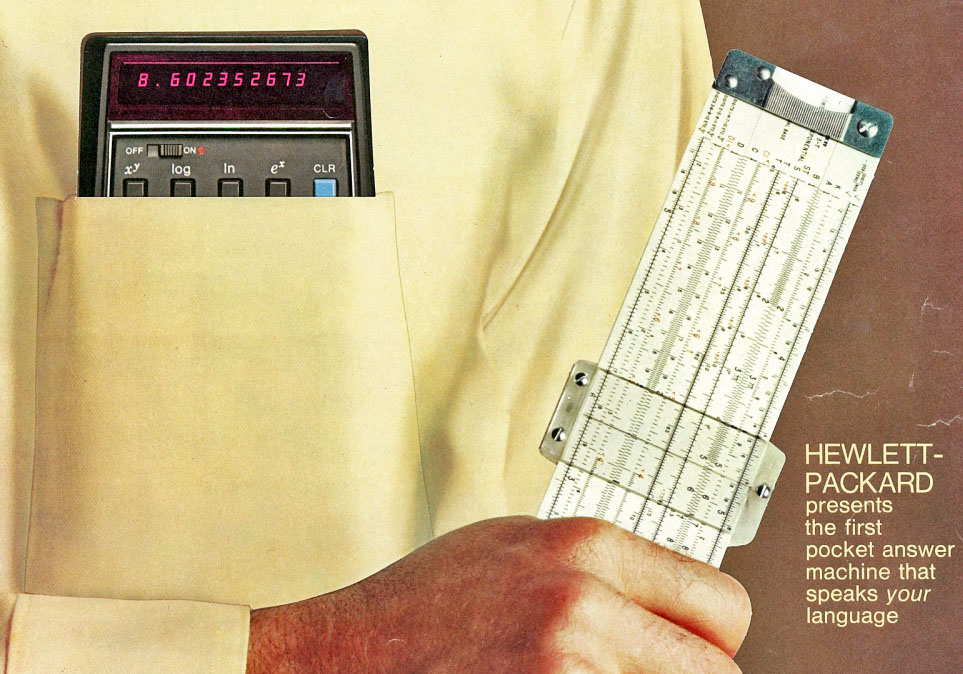
One of the highlights of my father's career in engineering
was the monumental leap from slide rule to the HP 35.

I was stuck with a schizoid model: Everything human was on the other side of the divide in my father’s male world. Female thoughts and opinions simply didn’t matter, and worse, formed some kind of cosmic threat to men. And yet, my father did not impose the standard “women are stupid, emotional, and should never attempt to think” regime on me, but encouraged my heresy. I think he also grasped that any censure of my particular interests would be fruitless. This conflict set me up for a lifelong interest in human behavior.

My hidden analysis of the family proved that both my father and mother were extreme cases of people who were locked into behavior they could neither understand nor modify. It turned out to be not that simple. Although their extremes were dysfunctional, each parent reflected common cultural beliefs promulgated by a particularly unhealthy supernatural script, which had been enacted over and over with tragic success for two millennia.  
When I look back to my childhood I see it ironically. The painful dysfunctional predicament in which I found myself provided material for a favorite type of Asperger challenge. What a mess! I bet I can figure it out. I'm still working on it.  

Friday, March 21, 2014

Wrong Answers Cause Wrong Behavior in Neurotypicals


Social conflict makes me ill. Literally.

Asperger people often find themselves in the awkward position shown by this graphic. Two groups of socially typical people fight over control of The Answer and neither group has a clue that The Answer they are fighting over is no answer at all; each group merely wants control.


The unfortunate Aspie (2) may or may not have the correct answer, but he or she knows that The Answer being fought over is simply not correct: the fight isn't about facts, but about which group is Right.

Asperger individuals are obsessed with problem-solving and want to get everyone on track toward finding a solution. The result is that both groups will turn on the Asperger and attack, often viciously, the one person who might be able to help.

Asperger people need to learn that Neurotypicals aren't looking for solutions at all! They love to fight, and are addicted to negative emotions, aggression and above all Winning, and they will argue unsuccessfully over the same topics again and again.  


Saturday, March 1, 2014

Support for the Asperger Experience of Emotion as Pain

FROM:  Your Brain: Your Pharmacist. Brain prescribes opioids for rejection – and rewards social acceptance with opioids! Posted on November 20, 2013 by consummatenovice

For the last decade researchers have found that emotional pain experienced from social rejection activates the same region of the brain that physical pain activates – the pain center. (see previous post "The Science of Pain, Empathy and Emotion) 

Scientists believe that since mammals live in social groups that are crucial to survival, social rejection is akin to a physical threat to our brain. A recent paper by Hsu et al. from the University of Michigan, has now shown that the same opioid receptors located in the brain’s pain center activated in response to physical pain are also activated by emotional pain and that the more opioid response an individual releases, the more that person scores high on the trait “resiliency”.  The study also found that the brain rewards social acceptance with activation of opioid receptors located elsewhere in the brain.

The brain protects itself from feeling too much physical pain by dosing itself with endogenous opioids. It lets you feel pain so you know that whatever it is you are doing should stop, but then alleviates its own pain by activating opioid receptors located in the pain center of the brain. Presumably, this neat self-soothing mechanism exists so when we get hurt we don’t just lie down and cry. (My personal experience points to the failure of this quenching or dampening of pain; the result is panic and anxiety that will escalate to unbearable levels.)
 
Given the similarities in the experience of physical and emotional pain, scientists have hypothesized that emotional pain also results in opioid receptor activation. In this study, Hsu and Zubieta used a radiotracer specific for opioid receptors to visualize the release of endogenous opioids with PET imaging in response to stimuli.

Expectedly, rejected subjects felt more “sad and rejected” and less “happy and accepted,” while accepted subjects felt the opposite. Interestingly, subjects with high opioid activity rated themselves as lower in the “sad and rejected” scale. These findings suggest that individuals with a robust opioid response bounce back more quickly in the face social rejection. This data corroborates a study by Way et al. from 2009 which examined the differences in activation of the brain’s pain center in response to social rejection between people who have a normal opioid receptor gene and those who have a mutation in the receptor. The mutated receptor is thought to have greatly reduced function and carriers of this mutation have been shown to need greater amounts of opioids to treat physical pain (ex: post-surgical pain). Way and Eisenberg saw that carriers of the mutation had greater activation of the pain center than non-carriers.

These findings will hopefully lead to new therapies and interventions with individuals suffering from depression, social anxiety, and other psychological disorders.

Hsu, D. et al. Response of the μ-opioid system to social rejection and acceptance. Molecular psychiatry 18, 1211–7 (2013).